
USD/JPY Price Analysis: Sits near multi-month tops, above 106.00 mark post-US Retail Sales
- Sustained USD buying pushed USD/JPY to five-month tops on Wednesday.
- The recent rally in the US bond yields continued to underpin the greenback.
- Upbeat US Retail Sales data remained supportive of the pair’s positive move.
The USD/JPY pair edged higher during the early North American session and climbed back to five-month tops, around the 106.20-25 region in the last hour.
The US dollar remained underpinned by the recent runaway rally in the US Treasury bond yields and got an additional boost from Wednesday's upbeat US Retail Sales data. This, in turn, was seen as one of the key factors that continued lending some support to the USD/JPY pair.
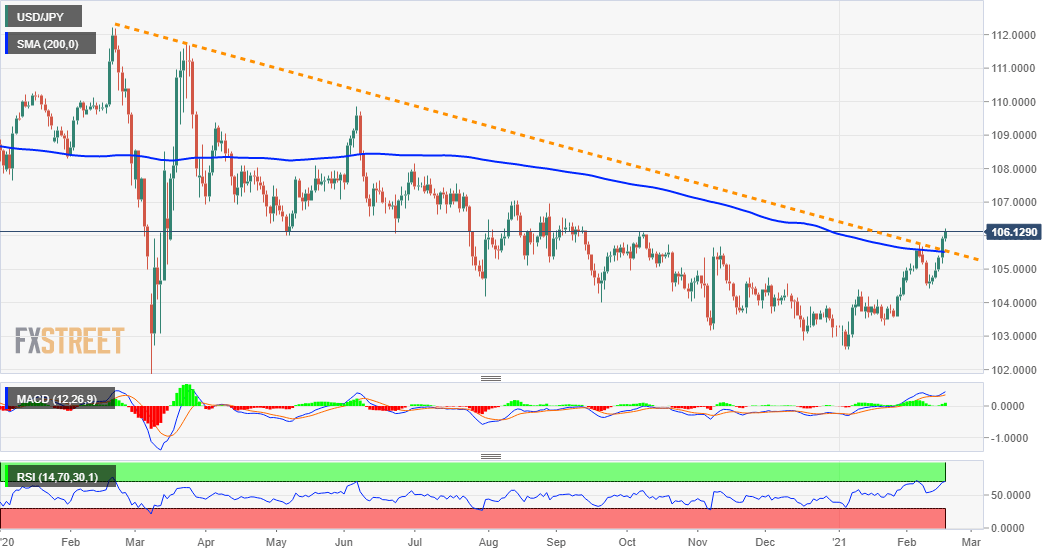
Given the overnight sustained break through the very important 200-day SMA and a one-year-old downward sloping trend-line confluence hurdle, the set-up favours bullish traders. That said, overbought RSI on short-term charts kept a lid on any further gains for the USD/JPY pair.
Hence, it will be prudent to wait for some near-term consolidation or a modest pullback before traders start positioning for an extension of the bullish momentum. Nevertheless, the USD/JPY pair seems poised to surpass the 106.45 intermediate resistance and aim to reclaim the 107.00 mark.
On the flip side, any meaningful pullback is more likely to be seen as a buying opportunity and find decent support near the mentioned confluence resistance breakpoint, around mid-105.00s. This should act as a key pivotal point and help determine the USD/JPY pair's near-term trajectory.
USD/JPY daily chart
Technical levels to watch